
Introduction
One of the most important decisions you’ll make when choosing a mortgage is whether to select a fixed-rate
mortgage or a variable-rate mortgage.
While many homebuyers focus primarily on finding the lowest mortgage rate, the type of mortgage you choose
can have a significant impact on your monthly payments, long-term borrowing costs, financial flexibility, and
overall peace of mind.
There is no universal answer that works for every borrower. The right mortgage solution depends on your
financial goals, risk tolerance, lifestyle, and future plans.
Whether you’re purchasing your first home, refinancing an existing mortgage, or approaching your mortgage
renewal, understanding the differences between fixed and variable rates can help you make a more informed
decision.
Understanding Mortgage Interest Rates
Your mortgage interest rate determines the cost of borrowing money from a lender.
Even a small difference in interest rates can have a significant impact on:
– Monthly mortgage payments
– Total interest paid over time
– Cash flow flexibility
– Long-term financial planning
– Wealth-building opportunities
Because of this, choosing the right mortgage structure is just as important as securing a competitive rate.
What Is a Fixed-Rate Mortgage?
A fixed-rate mortgage provides an interest rate that remains unchanged throughout your mortgage term.
Whether you choose a:
– 1-Year Fixed Mortgage
– 3-Year Fixed Mortgage
– 5-Year Fixed Mortgage
– 7-Year Fixed Mortgage
– 10-Year Fixed Mortgage
your mortgage rate remains locked in until the term expires.
For example, if you secure a 5-year fixed mortgage at 4.49%, your mortgage rate remains exactly the same for
the entire five-year term, regardless of what happens in the economy or interest rate markets.
Benefits of a Fixed-Rate Mortgage
1. Payment Stability
One of the biggest advantages of a fixed-rate mortgage is predictability.
Your mortgage payment remains unchanged throughout the term, making budgeting easier and reducing
financial uncertainty
2. Protection Against Rising Interest Rates
If interest rates increase during your mortgage term, your rate remains locked in.
This protection can provide significant peace of mind during periods of inflation or economic uncertainty
3. Easier Financial Planning
Because payments remain predictable, homeowners can more confidently plan for:
– Investments
– Savings goals
– Family expenses
– Education costs
– Major purchases
4. Reduced Financial Stress
Many borrowers simply prefer certainty.
A fixed-rate mortgage removes much of the anxiety associated with changing interest rates and economic
headlines
Drawbacks of a Fixed-Rate Mortgage
Higher Initial Rates
Fixed mortgage rates are often slightly higher than variable mortgage rates when the mortgage is first
obtained.
Borrowers may pay a premium for the stability and protection that fixed rates provide.
Larger Penalties
Breaking a fixed mortgage before maturity can result in significant penalties.
Depending on the lender and remaining term, penalties can sometimes reach several thousand dollars.
Less Flexibility
Fixed-rate mortgages may not be ideal for borrowers who anticipate:
– Selling their property
– Refinancing
– Relocating
– Making major financial changes
during the mortgage term.
What Is a Variable-Rate Mortgage?
A variable-rate mortgage is tied to the lender’s Prime Rate.
Prime Rate is influenced by the Bank of Canada’s Overnight Lending Rate.
As Prime changes, your mortgage rate can increase or decrease.
For example:
Prime Rate: 5.00%
Variable Mortgage: Prime – 0.75%
Your mortgage rate: 4.25%
If Prime increases, your mortgage rate increases.
If Prime decreases, your mortgage rate decreases
Benefits of a Variable-Rate Mortgage
Potential Long-Term Savings
Historically, variable-rate mortgages have often outperformed fixed-rate mortgages over longer periods.
Many borrowers have paid less interest over the life of their mortgage by choosing a variable rate
Lower Mortgage Penalties
Variable-rate mortgages generally have lower penalties compared to fixed-rate mortgages.
This can be beneficial if you:
– Move
– Refinance
– Sell your property
– Change lenders
before the mortgage term ends
Greater Flexibility
Variable-rate mortgages can be attractive for borrowers who expect changes in their financial situation or
housing plans.
Potential Benefits During Rate Cuts
When the Bank of Canada lowers interest rates, variable-rate borrowers may benefit immediately.
Lower rates can reduce borrowing costs and improve monthly cash flow
Drawbacks of a Variable-Rate Mortgage
Potential Benefits During Rate Cuts
Unlike fixed mortgages, variable mortgage rates can increase.
This uncertainty can make financial planning more challenging.
Budgeting Challenges
Some homeowners find it difficult to budget when mortgage costs may change over time.
Emotional Stress
Even when the numbers favor a variable mortgage, not every borrower is comfortable watching rates fluctuate.
For many people, peace of mind has value.
How the Bank of Canada Impacts Mortgage Rates
The Bank of Canada plays a major role in determining borrowing costs across the country.
When inflation rises, the Bank of Canada may increase interest rates to slow spending and stabilize prices.
When economic growth slows, the Bank may lower rates to encourage borrowing and investment.
Impact on Variable Mortgage Rates
Variable-rate mortgages respond directly to changes in Prime Rate.
If the Bank of Canada increases rates:
– Prime Rate rises
– Variable mortgage rates rise
If the Bank lowers rates:
– Prime Rate falls
– Variable mortgage rates fall
Impact on Fixed Mortgage Rates
Fixed mortgage rates are not directly tied to the Bank of Canada’s overnight rate.
Instead, they are influenced by:
– Government bond yields
– Investor expectations
– Economic forecasts
– Inflation outlook
As a result, fixed rates can move even when the Bank of Canada has not changed its policy rate.
Fixed vs. Variable Mortgage Comparison
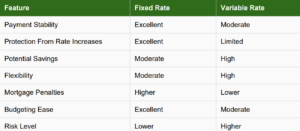
Which Mortgage Is Better During Falling Rates?
When interest rates are expected to decrease, variable-rate mortgages often become more attractive.
Borrowers may benefit from:
– Lower monthly payments
– Reduced borrowing costs
– Increased cash flow
– Potential long-term savings
Which Mortgage Is Better During Rising Rates?
When interest rates are expected to increase, fixed-rate mortgages often provide greater protection.
Borrowers can lock in their rate and avoid future increases.
This stability can be particularly valuable during periods of economic uncertainty.
Mortgage Renewals: The Perfect Time to Reassess
Many homeowners simply sign the renewal offer sent by their current lender.
This can be a costly mistake.
A mortgage renewal provides an opportunity to:
– Compare mortgage rates
– Explore new lenders
– Reassess fixed vs. variable options
– Review financial goals
– Improve mortgage flexibility
Many borrowers discover significant savings by reviewing their options before signing a renewal offer.
Common Mistakes Borrowers Make
Focusing Only on Interest Rates
The lowest mortgage rate is not always the best mortgage.
Other factors matter, including:
– Mortgage penalties
– Prepayment privileges
– Portability
– Flexibility
– Future plans
Following News Headlines
Mortgage decisions should be based on your financial situation, not media predictions.
No one can predict future interest rates with certainty.
Ignoring Mortgage Penalties
Breaking a mortgage can be expensive.
Understanding potential penalties before signing is essential.
Frequently Asked Questions
Is a fixed mortgage safer?
Generally, yes.
Fixed mortgages provide predictable payments and protection from rising rates.
Is a variable mortgage cheaper?
Historically, variable mortgages have often resulted in lower borrowing costs over longer periods, but future
performance is never guaranteed.
Can I switch from variable to fixed?
In many cases, yes.
Most lenders allow borrowers to convert a variable mortgage into a fixed mortgage during the term.
What mortgage term is most popular in Canada?
The 5-year term remains one of the most popular mortgage terms among Canadian homeowners.
Should first-time homebuyers choose fixed or variable?
Many first-time buyers prefer fixed rates because of the stability and predictability they provide.
However, every situation is unique.
Final Thoughts
There is no universally perfect mortgage.
The right choice depends on your:
– Financial goals
– Budget
– Risk tolerance
– Future plans
– Comfort level with changing rates
For some homeowners, the stability of a fixed-rate mortgage provides valuable peace of mind.
For others, the flexibility and potential savings of a variable-rate mortgage may be the better fit.
The most important thing is understanding your options and choosing a mortgage strategy that aligns with your
long-term financial objectives.
Need Help Choosing Between Fixed and Variable?
Every homeowner’s situation is different.
Whether you’re buying your first home, refinancing your existing mortgage, or approaching a renewal,
professional advice can help you make the right decision.
Contact Aashish Sood today for a personalized mortgage consultation and discover which mortgage
solution is right for you
Mortgages with Aashish | 416-697-8745 | aashish@lendinghub.ca